
Greenhouse Frog
Latin Name: Eleutherodactylus planirostris
Species: Amphibian
Conservation Status: SNR (exotic/introduced)
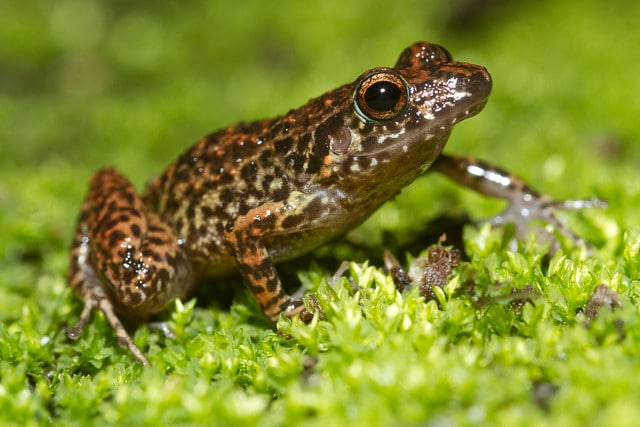
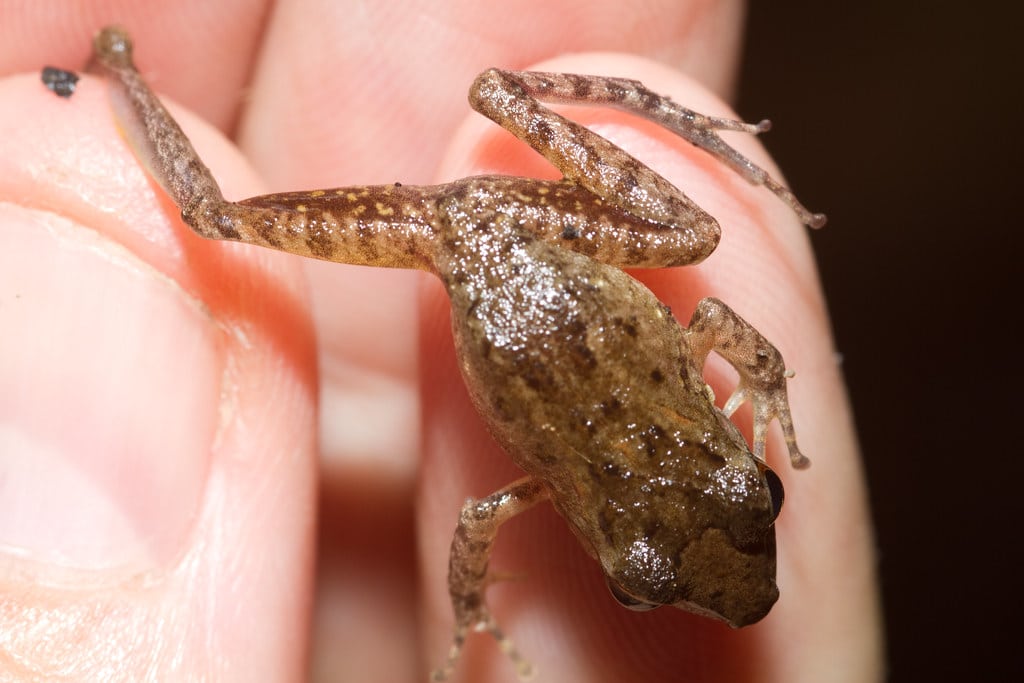
Greenhouse frogs are a small, non-native species found here in South Carolina. Their back is brown, reddish-brown, or bronze, and their belly is light gray or white. They can have mottled brown splotches on their back, chevron bands between their eyes, or two stripes running from their eyes to their back legs. Instead of webbed feet, they have long, slender toes with tiny toepads. They typically measure between 0.5 and 1.2 inches in length (12-30 mm).
Range & Habitat (map)
Greenhouse frogs are native to several Caribbean islands, including Cuba and the Bahamas. They were likely brought to the United States via Caribbean imports, and were initially introduced to Florida and Georgia. They now inhabit coastal South Carolina, Georgia, and Florida, and are occasionally seen in Louisiana and Alabama. Greenhouse frogs are a terrestrial species, meaning that, unlike most frogs, they spend their entire life on land. They prefer to inhabit moist, warm areas on or near the ground, such as in gardens.
Diet
Greenhouse frogs typically eat insects such as beetles and ants; however, they’ll sometimes eat any small invertebrate or arthropod that fits in their mouth.
Life History
Unlike many native frogs, greenhouse frogs don’t lay eggs in water and don’t have a tadpole stage. They lay eggs in damp places like potted plants or under vegetation. Breeding season runs from late spring through summer (May-September). Males prefer to mate at night, preferably during heavy rain, high humidity, or even near a sprinkler system. They call to females in a series of four to six chirps. Females lay up to 20 eggs which she guards for around two weeks. The embryos hatch directly into froglets, skipping the tadpole stage—a process known as direct development. Froglets measure no longer than a quarter of an inch, with a small nubbed tail and fully developed limbs. Within a year, they reach sexual maturity and become adult frogs.
Threats & How You Can Help
Greenhouse frogs don’t pose an immediate threat to native species or the ecological balance of their habitats. Concerns do exist about population growth, but both their size and the presence of larger predators help keep their numbers controlled. If you encounter a greenhouse frog in the wild, consider reporting its location to a citizen science program that investigates population changes and effects on local ecosystems.
Additional Info
They were introduced to the area by hitchhiking on tropical plants, which may explain the name “greenhouse” frog. They are one of only two species east of Texas that lay eggs on land. They’re also among the one-third of frogs that exhibit direct development (no tadpole stage).