Although the oyster harvesting season officially opened on October 1 in South Carolina, the dropping water and air temperatures, along with the falling leaves, are a welcome signal across the Lowcountry that oyster roast season is upon us! But the next time you are getting ready to indulge in this briny delicacy, take a moment to consider the incredible role these species play in maintaining a healthy Port Royal Sound. In many ways, oysters represent the whole ecosystem in one slimy bite!
All Hail the Eastern Oyster
The Eastern Oyster (Crassostrea virginica) is the only commercially significant oyster species on the East Coast of the US. While oysters from Maine may look and even taste distinctly different from those growing in South Carolina or Florida, they are all the same species that have grown in different conditions, making oysters and their environment interdependent.

Oysters are bivalve mollusks, meaning they have a two-part hinged shell that contains and protects their soft body inside. They begin their lives in the summer months as tiny larvae drifting with the currents and undergoing rapid development. If they survive the three weeks or so it takes for them to develop appendages that help them attach to a hard surface, they will hopefully find a suitable structure and adhere themselves to it. In South Carolina, this often means attaching to older shells in raised oyster beds to form what we consider ‘clusters’. Once attached, the young oysters are considered ‘spat’ and begin the work of growing and building their shells.
Oysters are filter feeders. They get their nutrients by pumping water through their gills to trap suspended particles. The oyster sorts through the particles it has captured, separating and consuming plankton, algae, and other organic materials as food, and depositing non-edible particles, such as silt and sediment, as feces or by releasing them through its shell. This is a constant process that allows a single oyster to filter as much as 50 gallons of water per day – the equivalent of a little over 3 kegs of water – cheers to oysters! 🍻
As they eat and grow, oysters build their shells by extracting calcium carbonate from the water and secreting it on the inside of the shell, which forms layers. If you look closely at an oyster shell, you can see it’s made up of hundreds of very thin layers that build on each other to add length to the oyster. However, the shape the shell takes as the oyster grows is dependent on the conditions in which it’s growing. In South Carolina, most oysters are found in relatively shallow, salty, intertidal waters where there shells tend to grow as long and thin (as compared to oysters in the Chesapeake or Apalachacola regions where shells grow thicker and shorter). Most of the oysters we eat are at least three inches long, which an oyster typically reaches in 2 to 4 years.

Oysters & the Port Royal Sound
If you have been out on a boat on the Port Royal Sound or any of its tributaries at low tide, you know oyster beds are PLENTIFUL! Oyster beds or reefs are structures built up over time from oysters growing on other oyster shells. Beyond providing ideal habitat for oyster spat, oyster reefs serve as homes for many other species in the Sound, including various species of crabs, worms, and other invertebrates, and small fish (which in turn attract the bigger fish!).
Notice where oyster beds thrive – in the intertidal zone where they are submerged at high tide and exposed at low tide. This area is where oyster shells are most valuable, which why its so important to properly recycle your shells – so they can go back into the environment in locations where they are the most helpful.
Recycling Your Oyster Shells
Notice where oyster beds thrive – in the intertidal zone where they are submerged at high tide and exposed at low tide. This area is where oyster shells are most valuable, which why its so important to properly recycle your shells – so they can go back into the environment in locations where they are the most helpful.
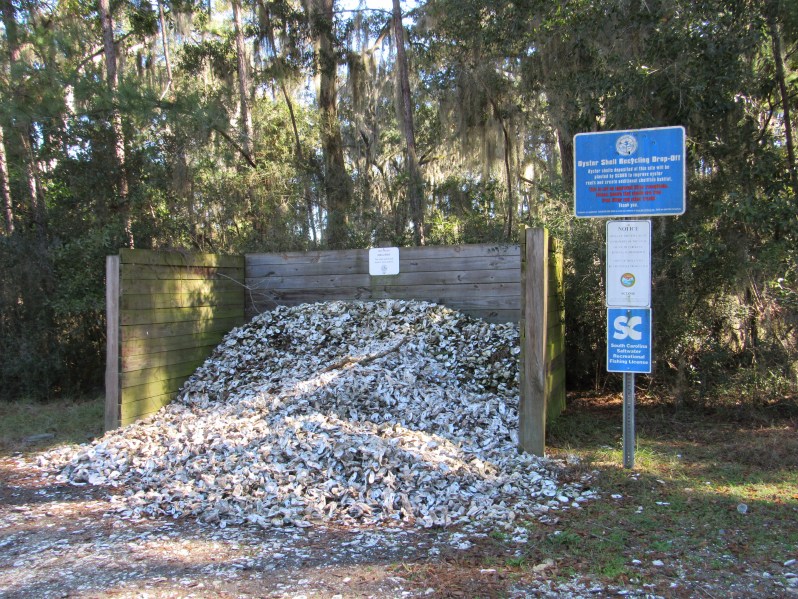
The SC Department of Natural Resources operates the South Carolina Oyster Recycling and Enhancement (SCORE) program, which facilitates both oyster shell recycling and community-based oyster bed restoration work. In the Port Royal Sound area, SCDNR operates five oyster shell recycling drop-off locations where oyster shells can be deposited to be cleaned and repurposed into living shoreline projects. At this point, the demand for local oyster shell for restoration projects exceeds the supply, and oyster shell is being imported from neighboring states to support local projects. So, please don’t just dump your oyster shells randomly in the marsh, where they do no good, and please don’t throw them away. Oyster shells are a valuable resource for the conservation of the Port Royal Sound.
Harvesting Oysters
Interested in harvesting your own oysters? It’s fun, be sure to know the laws and how to harvest in a way that doesn’t undermine the health of the fishery!
- Recreational harvest of shellfish (clams, oysters and other molluscan bivalves) requires a South Carolina Saltwater Fishing License
- Shellfish may be harvested recreationally from State Shellfish grounds (labeled with an S) and Public Shellfish grounds (labeled with an R) with a Saltwater Recreational Fishing License.
- October 1 through May 27. It is illegal to harvest shellfish between 1/2 hour after official sunset and 1/2 hour before official sunrise.
- Two U.S. Bushels of oysters may be harvested per person, per day. No person may gather more than one personal limit of shellfish on more than two calendar days per any seven day period. There is a maximum possession limit of three personal limits per boat or vehicle or boat and vehicle combination.
- It is unlawful to use scoops, scrapes, tongs, or dredges to take shellfish without a permit.
- Best practice is to “cull in place”, which involves breaking off and leaving smaller and dead oysters behind when harvesting, allowing future generations of oysters to grow and reseed the beds. Harvesters should break apart clusters and use a tool like a hammer to do so, leaving the smaller, viable oysters to continue growing.
Be sure to check current rules and regulations – https://www.dnr.sc.gov/marine/shellfish/regs.html