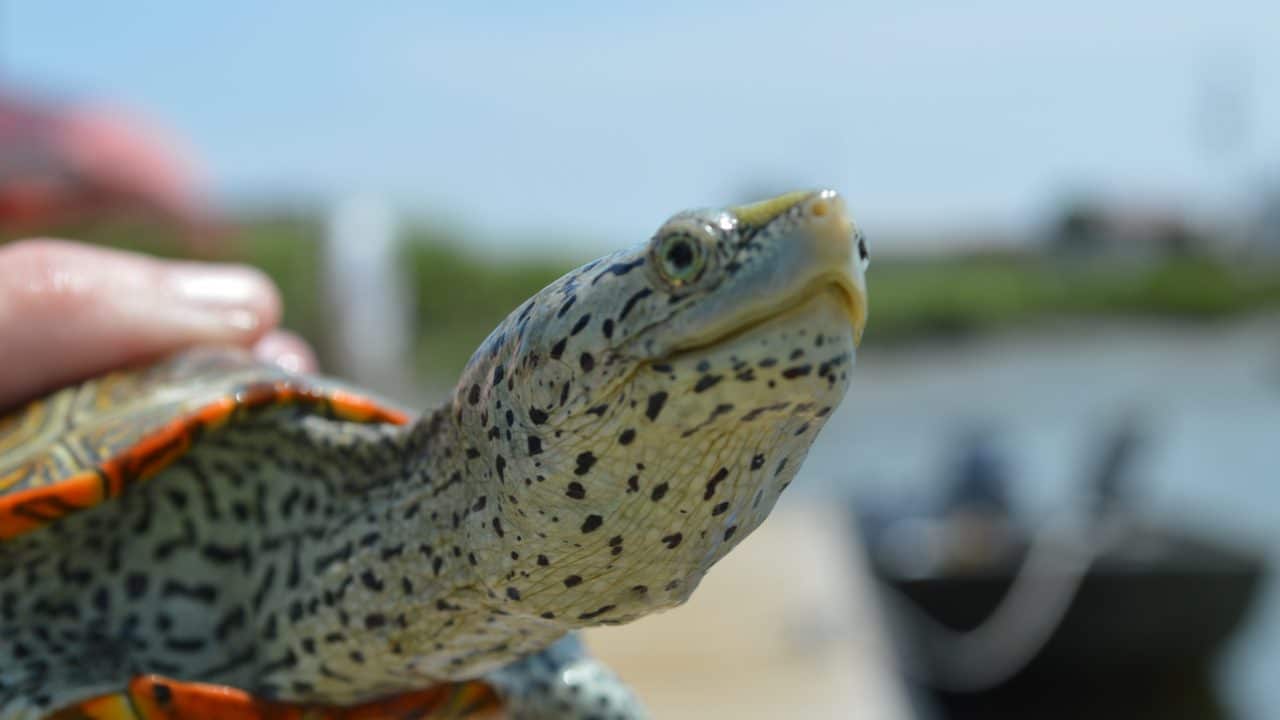

Only one species of turtle is found year-round in Lowcountry salt marshes – the Eastern Diamondback Terrapin (Malaclemys terrapin centrata). This elusive species spends its entire life deep in the marsh, in shallow creeks with little human traffic, making them challenging to study. While there is much we don’t know about these creatures, they can reveal a great deal about the health of our marshes and estuaries. To study and assess the well-being of these species in this region, the Port Royal Sound Foundation, in partnership with the University of South Carolina – Beaufort (USCB), Lowcountry Ecological LLC, Sewanee University, Turtle Survival Alliance, and SCDNR has launched the Beaufort Terrapin Project to study and assess these turtles in the Port Royal Sound.
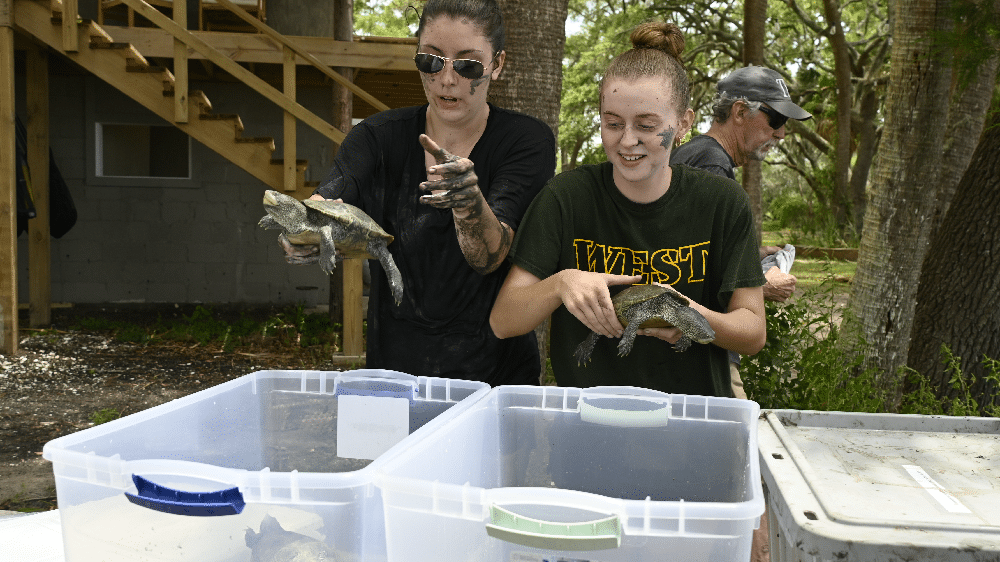
In mid-June, 25+ students, researchers, and volunteers with the Beaufort Terrapin Project spent two days neck deep in the creeks that wind through St. Helena Island, working as teams to pull 30-foot long seine nets through the salt water and rich black pluff mud. Together, they caught, measured, and recorded 20 diamondback terrapins – 6 females and 14 males. Most of the females were carrying eggs and were released after being measured and recorded. Males were held overnight to prevent recapture during the second day of surveying and were released unharmed.

“Monitoring these turtles helps us deepen our understanding of the Port Royal Sound and observe trends as different pressures from people influence this habitat,” said Jake Zadik, co-founder of the South Carolina Partners in Amphibian and Reptile Conservation (SCPARC) and one of the organizers of the terrapin survey.
The Small but Mighty Terrapin
The smallest of all the terrapin subspecies in the US, this estuarine turtle makes a living munching on hard-shelled animals such as crabs and snails. Terrapins tend to float on top of the water with just their eyes and noses exposed, diving down at the first sight of potential danger. These charismatic turtles serve as good indicator species as they are impacted by changes in our tidal creeks and increasing human and boat traffic.
As an example of convergent evolution, the diamondback terrapin has evolved traits similar to sea turtles to survive and thrive in our high-salinity environment. Like sea turtle species, terrapins have postocular lacrimal glands that enable them to dilute and secrete salt water absorbed through their skin as tears, thereby maintaining homeostasis. Like other living organisms, they require freshwater to survive. They can drink this water from the thin layer of freshwater that forms on the top of seawater after a rain event, and they can store that freshwater in sacks at the base of their hind legs to use later. If you’re deep in a tidal creek during a rainstorm, look for terrapins popping their head out of the water with their mouths open to catch the raindrops!

Diamondback terrapins live for 25 to 40 years in the wild and spend their whole lives in the area where they were born. In fact, researchers think that terrapins spend the first several years of their life hiding out under the wrack or mats of dead marsh grass that make up the base of our marsh ecosystem.
“Terrapin’s long life span and high site fidelity make them a great study subject,” said Chris Kehrer, Science Program Manager at the Port Royal Sound Foundation and one of the organizers of the Beaufort Terrapin Project. “We are excited to be able to work with great partners to study the populations of these cryptic species in our marshes.”
Threats to Terrapins
Historically, one of the most devastating influences on the diamondback terrapin population in the region was our soup pots! Once a staple in human diets, terrapins became a delicacy through the late nineteenth century, driving demand and harvest rates of these turtles to near extinction. Today, the commercial harvest of terrapins is prohibited, and the species is considered a “high priority” species in the South Carolina Wildlife Action Plan.
Though protected, these species continue to face challenges. One obvious threat to diamondback terrapins is the loss and disruption of their habitats. Several of the individual turtles captured as part of this summer’s census had damage to their shells, which was likely caused by being struck by boat propellers. These turtles are also susceptible to road mortality. Nesting females tend to seek shady, sandy areas above the high-tide line – areas that are often shared with causeways that run through their preferred nesting habitat. The Beaufort Terrapin Project, with assistance from Lowcountry Ecological LLC. and the Turtle Survival Alliance, is developing a program to report and record turtle mortality along Sea Island Parkway – a hotspot for terrapin vehicle strikes. This data will help build the case to invest in mitigation strategies such as flashing crossing signs, barriers, and underpasses that have proven effective in places like Jekyll Island, GA and Kiawah Island, SC.
Another threat to diamondback terrapins is actually crab traps. Turtles breathe air, and if they get stuck in a crab trap, they are unable to swim to the surface, and they drown. The Turtle Survival Alliance reports having found crab traps with dozens of terrapins trapped inside that had drowned. A significant development to reduce this mortality rate is the Bycatch Reduction Device (BRD), a small plastic cutout installed at the entrance to the crab trap that keeps turtles from getting through. BRDs are not required on crab traps in South Carolina but are highly recommended to help our terrapins.
The Beaufort Terrapin Project
The Beaufort Terrapin Project is a collaborative effort to monitor, assess, and help protect these unique turtles in the Port Royal Sound area, and is building a lot of excitement. Port Royal Sound Foundation, University of South Carolina – Beaufort (USCB), Lowcountry Ecological LLC, Sewanee University, Turtle Survival Alliance, and SCDNR are working together to understand the state of terrapins in the region and identify opportunities to ensure they thrive into the future.
“Field experiences like this give students a firsthand look at how science and conservation really happen. This project is a great example of what we can accomplish when universities, students, and local conservation groups come together with a shared goal,” said USCB assistant professor of Ecology and Evolution Ryan Hanscom. Hanscom is also going to be placing bio-loggers on captured turtles to provide minute-to-minute inputs on their activities and behaviors. These loggers will tell us when and where these turtles are foraging, resting, and nesting to help hone in our conservation and protection efforts.
“As the Beaufort Terrapin Project grows, we hope the buzz around these special estuarine turtles will too,” said Kehrer. “You can help by submitting any terrapins that you come across, either nesting females in your backyard or populations in your favorite creek, by going to Terrapin Sightings on SCDNR’s website.”
Future efforts will likely include further examination of male and female habitat use, gear improvements, and more focused work in promising areas across the Port Royal Sound Watershed.