

Consider how many uses of freshwater you come across in a given day. How do we ensure the state has enough water for people to drink and wash, to turn the state’s turbines and the wheels of industry; for crops, grass, and trees to grow; and still have water for fish and other wildlife to swim in? And how do we plan to make sure we have enough water to continue growing 50 years from now?
Water is a renewable but limited critical resource for the state of South Carolina, which the SC Department of Environmental Services (SCDES) is responsible for managing. For the last six years, SCDES, the SC Department of Natural Resources (SCDNR), and the South Carolina Water Resources Center at Clemson have been managing the process to update the state water plan to ensure the state has adequate water for the next fifty years. This process has followed a river basin approach, with councils of stakeholders in each of the eight defined river basins working through data and models to project the supply and demand of water in that basin, and developing a plan for its management over the next fifty years. Then, these eight basin plans are being rolled up into an updated state water management plan.
This month, the plan for the Salkehatchie and Lower Savannah River Basin (which includes the PRS watershed) has been released for review and public comment. From the Port Royal Sound Foundation, former Board Chair Dean Moss and Director of Conservation Courtney Kimmel have been involved in the process to ensure that the interests of the Port Royal Sound and its surrounding communities were represented. “This part of the state is growing very fast. Understanding and managing the water supply for all of our needs is of critical importance to the future of the region,” said Moss. “This plan is a great start to helping us figure that out. It’s not the end of the story, but it consolidates what we know about the supply and demand for water, and highlights the gaps where we still need to learn more.”
The Draft of the Plan and instructions for providing public comment can be found HERE. To provide some context, Dean and Courtney have put together some FAQs.
The LSS River Basin Plan is a collection of water management strategies designed to ensure the surface and groundwater resources in the basins will be available for all projected uses, even under drought conditions, for the next 50 years. The plan was developed by a River Basin Council comprising representatives from various interest groups within the basin, including industry, public utilities, agriculture, energy, environment, and recreational uses. Hydrological models and extensive data reflecting current water use, current permitted and registered water use, and projected water use were used to assess current and future water availability. With that data and with extensive analysis and support from a range of experts, the LSS River Basin Council developed a plan that included policy, legislative, regulatory, technical, and planning process recommendations regarding the State’s water resources.
SCDES divided the state into eight river basins defined by drainage patterns, but the basin in which the Port Royal Sound is situated is defined more bureaucratically than geologically or hydrologically for planning purposes.
To the west is the Savannah River, which also serves as our border with Georgia. While the Savannah River is one continuous river flowing from Elliot Rock to the Atlantic Ocean at Tybee Island, it is divided into the Upper and Lower Savannah Rivers for planning purposes because the two sections are managed completely differently. The Upper Savannah contains a series of dam-controlled lakes and reservoirs, which the U.S. Army Corps of Engineers manages. The Lower Savannah is mostly free-flowing below the locks and dams at Augusta, and is the source of significant surface water withdrawals.
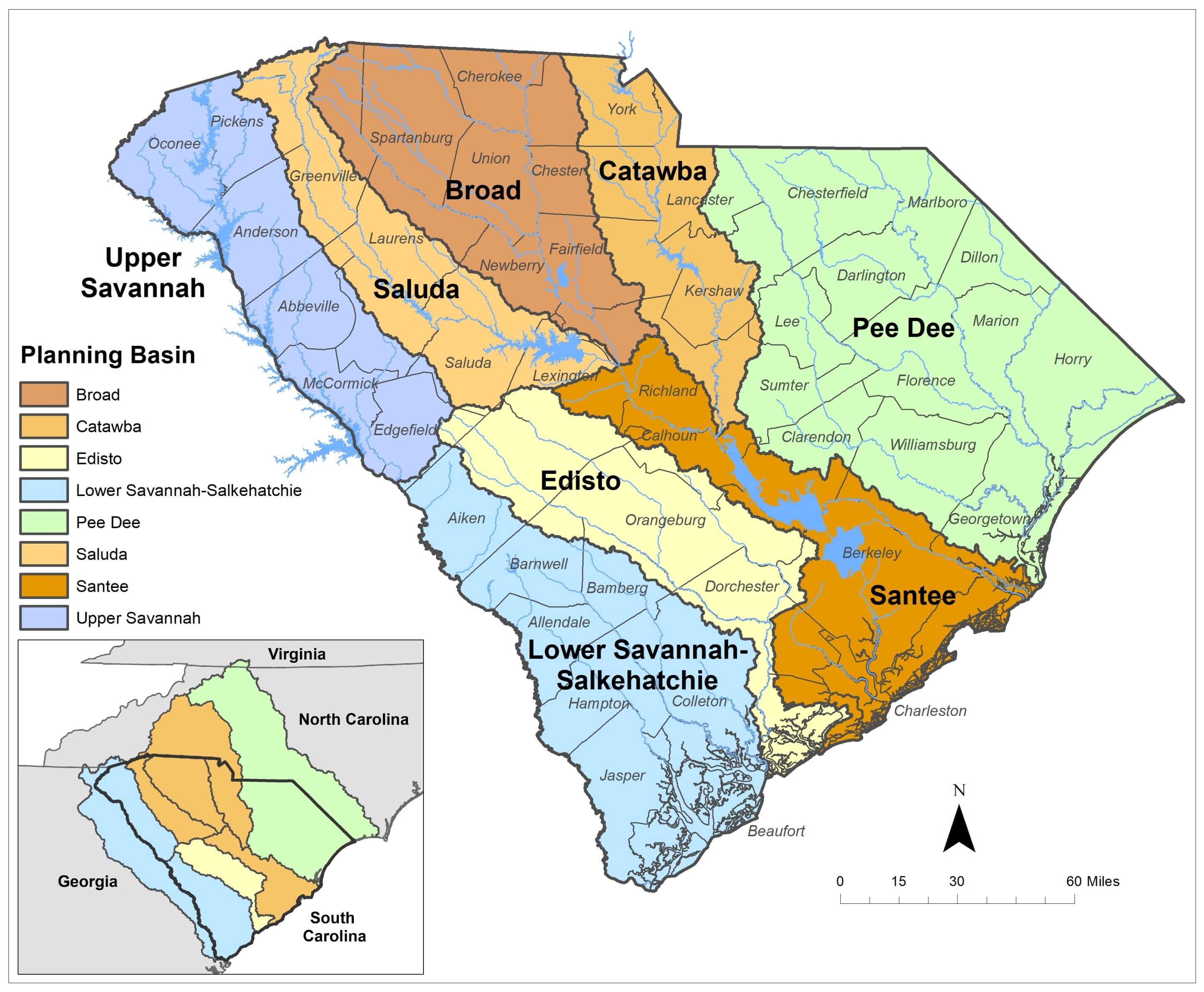

The Salkehatchie Basin is located east of the Savannah River Basin and encompasses the Salkehatchie, Combahee, and Ashepoo Rivers, as well as the Coosawhatchie and Tulifiny, which serve as the headwaters of the Port Royal Sound. This is a relatively sparsely populated region, with the exception of the Beaufort-Hilton Head area on the coast, which incidentally receives the majority of its drinking water from the Savannah River. The tributaries of the Salkehatchie Basin are predominantly shallow, blackwater bottomland swamps, and the predominant use of water from this region is agriculture.
The state combined the planning process for these two basins primarily to ensure participation, although the basins were evaluated separately, and different planning scenarios were developed for each.
The Port Royal Sound watershed actually spans these two basins, with inputs and influences from both. Since the primary focus of this planning process was water QUANTITY and ensuring the availability of water for consumptive needs into the future, and since there is very little withdrawal of surface water from the Port Royal Sound, this did not present significant concerns.
This plan evaluates surface water and groundwater withdrawal capacity in the basins to support water demands. What is interesting is that, in much of the lower Port Royal Sound watershed, we don’t withdraw surface water from the Sound – we get it from the Savannah River. The Beaufort-Jasper Water & Sewer Authority (BJWSA) maintains a system that withdraws most of its water from the Savannah River. The water is then treated at one of two treatment plants and distributed via pipes throughout the region. Where there is no BJWSA-provided water, there are wells that pull water from aquifers below ground. And in some instances, notably on Hilton Head Island, water is pumped from the Savannah River back into aquifers to recharge and store water underground.
In the upper portion of the PRS watershed, surface water from the Salkhatchie and Coosawhatchie is mostly used for small agricultural irrigation, and groundwater is used to support small municipal public utilities.
No. Making saltwater into a potable water source requires investing in desalination processes and equipment, which is quite expensive. That is not part of the current water management strategy, so the projected water supply only accounts for freshwater.
No. The scope of this particular planning process was explicitly focused on managing water QUANTITY – in other words, making sure we have enough water to meet all of the various needs into the future. Members of the River Basin Council and agency representatives recognized and acknowledged that water quality is important and should be addressed as a next step, but it is not included in this plan.
Yes. According to the models and data used in the process, there appears to be enough water in both basins to meet demand IF supply remains constant AND demand remains within projections. However, there are some gaps in the data that suggest we should take a more conservative approach to water use in the region.
One thing to note is that water modeling is complicated because it relies on making numerous assumptions. As they say, all models are wrong, but some are useful. One central question concerns the impact of climate change on our region’s water supply. Among other things, climate change is changing weather patterns, which could result in more or less annual rainfall, or more (or longer) severe droughts. Another issue, especially on the coast, is sea level rise and its impact on groundwater salinity levels. On Hilton Head Island, they are pumping treated fresh surface water into the ground to try to counteract saltwater intrusion into aquifers from the ocean. Such dynamics could alter the availability of freshwater, and unfortunately, they are not accounted for in the models.
Another significant gap in the data and models is demand from outside of the region, or in our case, from across the state line in Georgia. South Carolina and Georgia share use of the Savannah River, but that doesn’t mean the two states coordinate their shared use. The portion of Georgia that uses the Savannah River is growing much faster than the South Carolina side, which is resulting in increasing withdrawal rates. While this planning process is based on assumptions of stable demand rates within the SC side of the basin, it does not account for what is coming out of the Georgia side. That could be a problem.
For a more detailed discussion of the recommendations in the plan, take a look at the plan’s EXECUTIVE SUMMARY. However, in general, the RBC encouraged the state to adopt a more proactive approach to data collection, modeling, coordination, and water management policies and regulations, taking into account some of the uncertainties.
Once the LSS River Basin Plan is considered complete (the goal is September 2025), the information and recommendations it contains will ideally* be incorporated into a statewide plan that will serve as the South Carolina State Water Plan to guide water management plans and policies for the state. A complicating factor is that, while the eight basins were going through the planning process, Governor McMaster issued Executive Order 2024-22, establishing the WaterSC Water Resources Working Group (WaterSC) to also develop a state water plan by the end of 2025. It’s unclear whether this declaration was made with knowledge of the planning process already underway to update the existing state water plan or if it was made with different goals in mind. It’s also unclear whether or how all of these plans will fit together to create a state-wide plan, but ideally, the data, findings, and recommendations from the eight basin-scale plans will feed into what emerges as the state-level plan.
Another challenge is that, while this plan is legislatively mandated, it is NOT a regulatory document, which means it does not set policy for the management of water resources. It would be more impactful if it were a plan presented to the state legislature and adopted as a policy document by the state.
Yes! Public comments on the plan are being accepted now until August 22. We suggest at least reviewing the 2-page SUMMARY SHEET, specifically the recommendations, and then sending an email emphasizing the ones you feel are most urgent. One that we at PRSF feel is most important is coordinating with Georgia on the use of the Savannah River. Comments should be directed to Dr. Tom Walker at scwatermodels@clemson.edu