
Ask Chris his favorite time of year, and he’ll tell you it’s when the weather turns warm, the days stretch longer, and he finds himself knee-deep in pluff mud, chest-deep in tidal currents, hauling 30-foot nets across winding creeks. After all that effort, Chris and the team of volunteers that make up the Beaufort Terrapin Project sift through rays and sharks, hoping to find one very special catch at the bottom: a terrapin. Welcome to Terrapin Season!
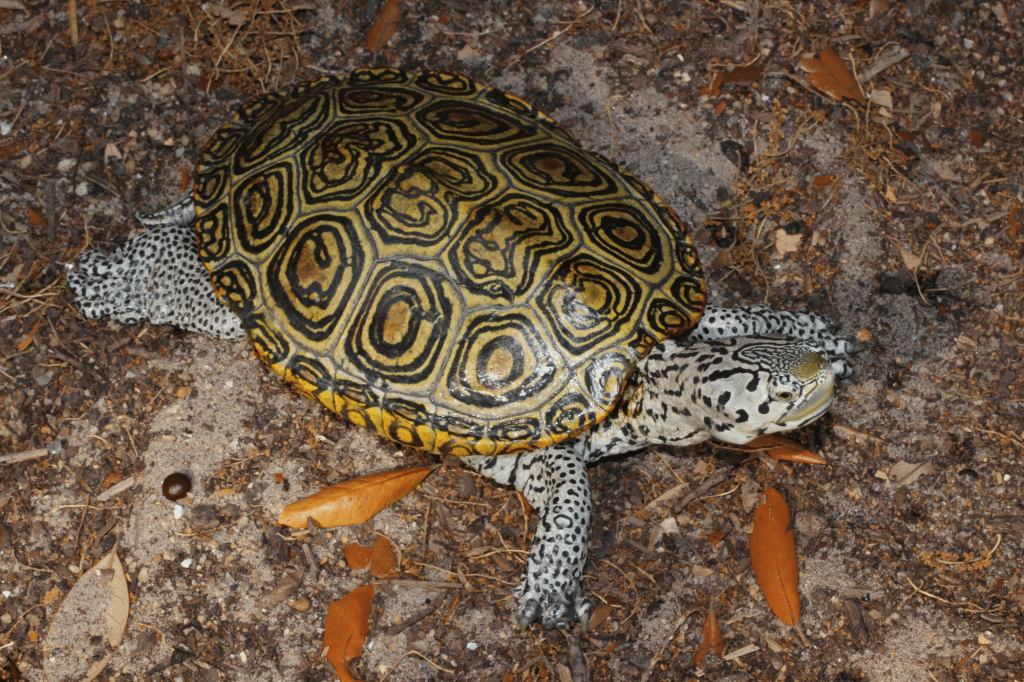
The Carolina Diamondback Terrapin (Malaclemys terrapin centrata) is one of seven subspecies increasingly vulnerable to localized extinction. Their long lifespans and strong site fidelity—rarely leaving their home creeks—make them especially susceptible to environmental change. They’re undeniably beautiful, often considered among the most striking turtles in North America, but their importance goes far beyond appearance. Terrapins are key indicators of salt marsh health—a kind of “canary in the coal mine,” or perhaps more fittingly, a terrapin in the wrack line.
These “diamonds of the marsh” face a growing list of threats: habitat loss, climate change, crab pot entanglement, predation, poaching, and vehicle strikes during nesting season. Populations across the eastern seaboard are declining. In South Carolina, terrapins are listed in the State Wildlife Action Plan (SWAP) due to these downward trends, and the Center for Biological Diversity has petitioned to have them protected under the Endangered Species Act.
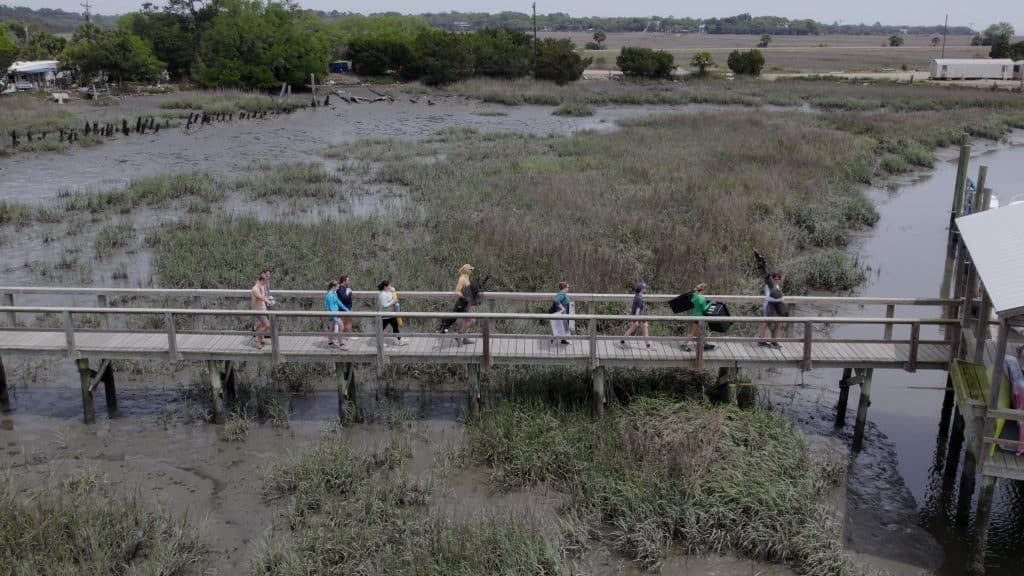
The Beaufort Terrapin Project is working to change that. Through a collaborative partnership, the project monitors local populations of Eastern Diamondback Terrapins within the Harbor River estuarine system. Because terrapins are elusive and inhabit complex environments, studying them is both difficult and time-intensive—and much remains unknown. This work depends on a strong coalition, including the Port Royal Sound Foundation, Lowcountry Ecological LLC., University of South Carolina Beaufort, Turtle Survival Alliance, South Carolina Department of Natural Resources, South Carolina State Parks, and Coastal Expeditions. So much effort for one species? Absolutely—because protecting terrapins means protecting the entire marsh ecosystem.
Monitoring terrapins is a multi-step, long-term effort that continues to evolve. First, we have to find them. That means navigating shallow creeks by small boat—or on foot—searching for a head the size of a gum ball breaking the water’s surface. Once terrapins are located, teams coordinate around low tide, assembling boats, nets, and volunteers. Some creeks require just a handful of people; others demand crews of up to 30, hauling multiple seine nets through thick mud and strong currents.

It’s hard, messy work—but it’s hard not to smile when you’re covered in mud and part of something bigger.
Captured terrapins are brought back to a temporary field station, where they are measured, photographed, tagged, and assessed for health. Each individual is added to a growing database, creating a long-term record of population trends and movement. At the end of the day, every terrapin is returned safely to its home creek.

Now in its third year, the project is already making an impact. More than 60 students have gained hands-on field experience, and data collected is helping inform discussions with the South Carolina Department of Transportation to reduce roadway mortality of nesting females along Sea Island Parkway. New research opportunities—from bio-logging to population genetics—are on the horizon, and momentum continues to build.
Want to help? If you spot a terrapin, take a photo and use this link to report it, REPORT TERRAPIN. If you encounter an injured terrapin, reach out to the Port Royal Sound Foundation for assistance at Ckehrer@portroyalsoundfoundation.org. To learn more—or see one up close—visit the Maritime Center. And if you’d like to support this work, consider making a donation to help advance terrapin research and conservation, https://portroyalsoundfoundation.org/donate/.