

The mission of the Port Royal Sound Foundation is to conserve the Port Royal Sound for the environmental, cultural, and economic well-being of our area. Essential to this mission is having a clear understanding of what is happening in the watershed, detecting changes quickly, and being able to respond before an issue becomes a major problem. A critical set of indicators to monitor is around water quality — things like water temperature, salinity, dissolved oxygen, pH, total suspended solids, and chlorophyll and nutrient levels. Any of these measurements or parameters can tell us a lot about what is happening in the water and on the land surrounding it.
The state agency responsible for collecting and monitoring water quality data across the state is South Carolina Department of Environmental Services (SCDES, previously part of SC Dept of Health & Environmental Controls – SCDHEC). SCDES has collected water quality data at hundreds of sites in the Port Royal Sound watershed over the past 3 decades with about 12 sites providing historic long-term data, which provides us with valuable information about the trends we see in water quality over seasons and over the decades. But as an organization solely focused on this estuary, we felt we needed to gather data in more locations, and be able to have that data available more quickly than what the state is able to provide.
So in 2024, PRSF worked with SCDES to develop a “Level 2” water quality monitoring protocol to train volunteers to collect data considered credible for decision-making purposes — likely the first of its kind! With support from the Community Foundation of the Lowcountry and a generous philanthropic community, we worked with our developer partner Mērak Labs to develop a data portal and mobile app to streamline the data collection and analysis process. Through the generous contributions of donors and supportive communities, we purchased an initial set of seven state-of-the-art digital handheld water quality meters and kits to ensure accurate data collection. Through the development of an MOU with USCB, we set up a process for the USCB Water Quality Lab to analyze samples collected in the field and merge that data with field data. Finally, in March 2025, we began training volunteers to monitor sites across the lower watershed twice per month! We’re off!
High Resolution, High Frequency, Fast Turn-Around Monitoring
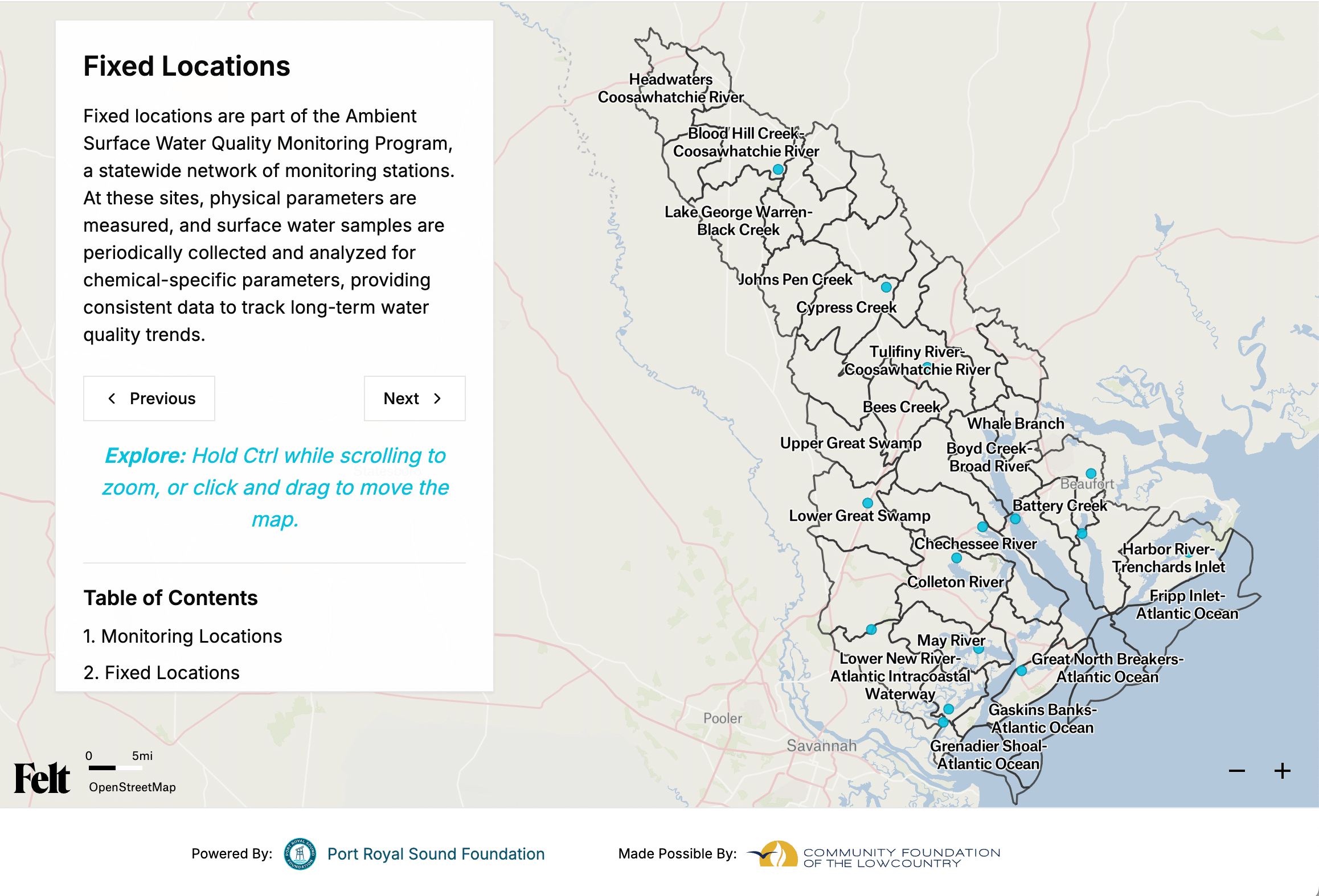
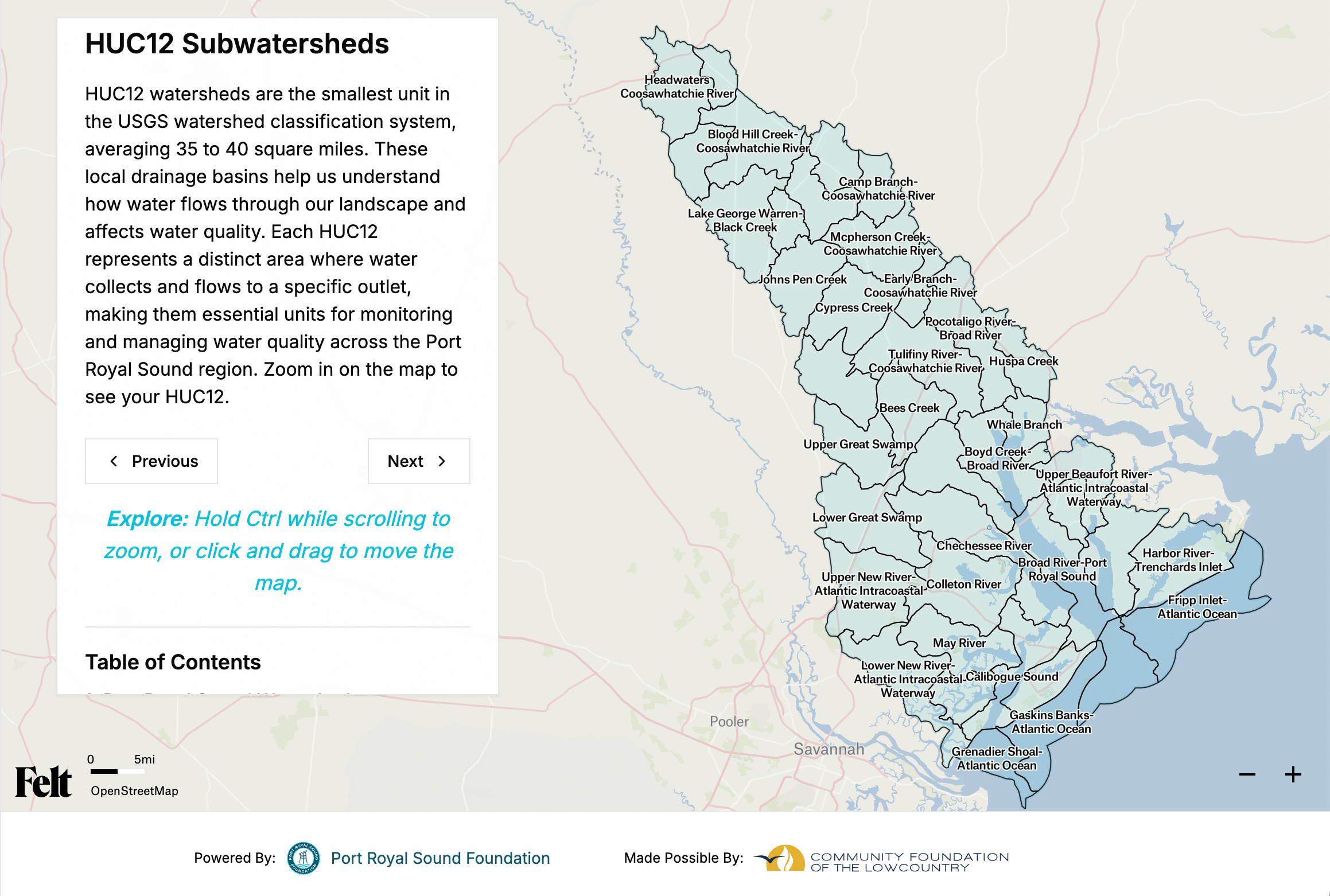
The goal for this Level 2 Monitoring program is to collect data from at least one site per subwatershed (what USGS refers to as the HUC12 level) in the lower portion of the Port Royal Sound watershed (south of I-95) at least two times per month. The map below illustrates the sites we are currently monitoring, with the option to add more as we start to identify areas of concern and as we build capacity.
Curating Data for Monitoring, Research & Decision-Making in the Port Royal Sound
Beyond the process of monitoring, the important stuff is in the interpretation of the data collected! In order to curate data specific to the Port Royal Sound, PRSF has been working with our partners at Mērak Labs to develop an online web portal that organizes different types of data into one place. Our first priority has been to display and quantify different land cover, and to organize water quality data — starting with the state SCDES data, and bringing our Level 2 Monitoring data into that mix.
The data portal is not available publicly yet, but you can see the types of data and how its being displayed in the slideshow below. We are currently working with partners and researchers to analyze data, ensure it’s displayed accurately, and to add more data layers that will be helpful in decision-making.


Getting Involved
The Level 2 Water Quality Monitoring program is only possible because of the generousity and commitment of our volunteers and our supporters. There are several ways to support the expansion and sustainability of this work.
Volunteer as a Field Investigator. In order to have consistent and reliable data, we depend on consistent and reliable volunteers who are willing to monitor sites twice per month, and to bring the samples to the Maritime Center or the USCB laboratory. Right now, we mostly have volunteer teams working in their communities, but we will be training and organizing Field Crews to monitor more remote sites starting in the fall. If you are interested in getting trained to serve as a Field Investigator for your community or as part of a Field Crew, be sure to sign-up for PR Sound Science Updates to receive announcements and updates on trainings.
Donate to Purchase Equipment. The Level 2 Monitoring protocol that was approved by the state requires us to use industry standard monitoring equipment, which is not cheap! We currently have seven monitoring kits, some of which have been assigned to partner communities. In order to have more equipment stationed around the Sound, we would need to purchase more kits. If you’re interested in donating funds to support equipment, let us know!
Serve as an Ambassador for PR Sound Science. As we collect more data and start to better understand what is happening in each subwatershed, we will be developing outreach materials and programs for communities, residents, and decision-makers in these specific areas. Click the map in this post to learn what subwatershed you live in, then, be sure to sign-up for PR Sound Science Updates to receive updates on information on your subwatershed, and opportunities to help get the word out!